

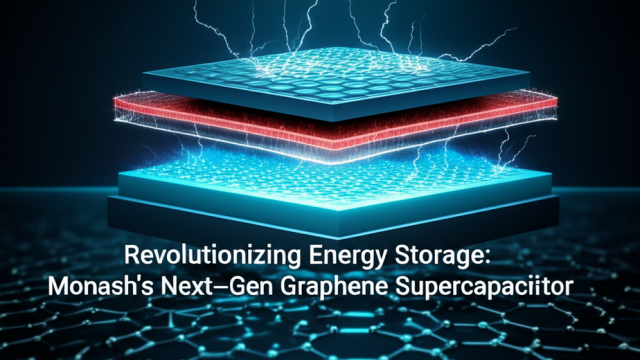
Graphene, a one‑atom‑thick sheet of carbon atoms arranged in a honeycomb lattice, has long been hailed as a wonder material. Its extraordinary electrical conductivity, mechanical strength, and flexibility make it a prime candidate for advanced energy devices. In a breakthrough announced by Monash University, researchers have engineered a novel graphene composite that redefines the capabilities of supercapacitors. Unlike conventional capacitors that trade off storage capacity for speed, this new material combines battery‑level energy density with charging times measured in milliseconds. The result is a next‑generation energy storage platform that could power everything from electric vehicles to handheld gadgets in a fraction of the time required today.
The secret behind Monash’s innovation lies in the meticulous design of the graphene architecture. By incorporating a hierarchical porosity and aligning graphene sheets at the nanoscale, the team achieved an unprecedented surface area—exceeding 2000 cm² per gram. This extensive interface allows ions to migrate rapidly during charging and discharging cycles, thus delivering the lightning‑fast response characteristic of traditional capacitors. Simultaneously, the robust electrochemical pathways ensure that energy is stored at densities comparable to lead‑acid or even lithium‑ion batteries. In laboratory tests, the composite recorded a specific capacitance of 250 F/g and a power density of 10 kW/kg, while maintaining a round‑trip energy efficiency above 95 %. These figures position the material as a true bridge between the speed of capacitors and the capacity of batteries.
Such performance gains have far‑reaching implications across multiple sectors. For electric vehicles (EVs), the ability to charge in seconds could eliminate long waits at charging stations, dramatically enhancing user convenience and accelerating the adoption of electric mobility. Consumer electronics could see devices that stay powered longer while still charging almost instantly—think smartphones that reach 80 % charge in 30 seconds or laptops that recharge a full battery in minutes. Beyond transportation, the technology could be a game‑changer for renewable energy integration, providing grid‑level storage that buffers solar and wind fluctuations without the lag associated with battery banks. The synergy between rapid response and high capacity also opens avenues in grid stabilization, micro‑grid resilience, and emergency power supplies.
Despite these promising results, several hurdles remain before commercialization becomes a reality. Scaling up the production of high‑purity graphene with consistent structural properties is technically demanding and costly. Moreover, ensuring long‑term cycle stability—particularly under high‑frequency charge‑discharge regimes—requires further material optimization. Safety considerations are also paramount; while graphene itself is relatively benign, the composite’s electrolyte formulation and packaging must meet stringent fire‑resistance and thermal‑management standards. Addressing these challenges will demand collaboration between academia, industry, and policy makers, along with investment in dedicated manufacturing facilities that can handle the delicate fabrication processes at scale.
In my view, Monash’s breakthrough heralds a paradigm shift in how we think about energy storage. By successfully marrying the speed of supercapacitors with the capacity of batteries, the research paves the way for devices that are both powerful and efficient. This innovation does not merely represent an incremental improvement; it offers a foundational technology that could reshape the infrastructure of our electric‑powered future. As we push toward greener, more resilient energy systems, the role of advanced materials like this next‑gen graphene supercapacitor will become increasingly critical. The road ahead may be challenging, but the potential rewards—a world where power is abundant, instantaneous, and sustainable—are well worth the pursuit.